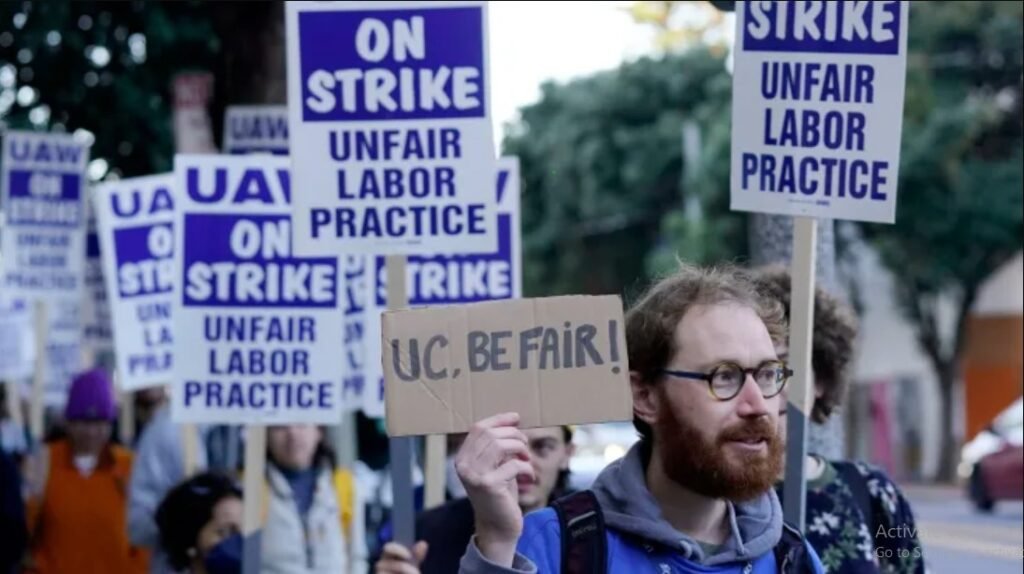
Peace Palace, seat of the International Court of Justice in The Hague, Netherlands/Wiki
Decoding the ICJ’s 2026 Advisory Opinion on ILO convention no.87
On May 21 2026 the international Court of Justice (ICJ) delivered a historic advisory opinion that effectively ended the fourteen-year systemic deadlock within the International Labour Organization (ILO). By a decisive 10-4 majority, the World Court (WC) affirmed that the right to strike is legally protected under ILO convention NO. 87. (Freedom of Association and Protection of the Right to Organize Convention,1948 (No.87).
This ruling is paradoxical in the sense that the word ‘strike’ appears nowhere in the text of Convention No. 87, making the Court’s determination highly extraordinary.
The Fourteen Year Deadlock
To understand why ILO took the exceptionally rare step of invoking article 37(1) of its constitution, one must examine the role of its independent supervisory body. Previously ILO’s independent supervisory body, the Committee of Experts on the Application of Conventions and Recommendations (CEACR), had consistently interpreted Article 3 of Convention No.87 as safeguarding the right to strike, as it was an essential corollary of freedom of association.
In 2012, the Employers’ Group within the ILO raised a coordinated institutional challenge. They argued that because the treaty’s text was entirely silent on industrial action, the committee of Experts had overstepped its mandate, effectively ‘legislating’ a right to which sovereign member states had never explicitly agreed to bind themselves in 1948. This particular institutional paralysis routinely disrupted the International Labour Conference’s supervisory mechanisms for over a decade, culminating in the Workers’ Group and 36 supportive governments successfully pushing for an ICJ referral in November 2023.
Textualism vs. Purposive interpretation: the ICJ’s Legal reasoning
The ILO Headquarters, Geneva/www.geneve-int.ch

The Hague pitted two fundamental methodologies of the Vienna Convention on the Law of Treaties (VCLT) during the legal battle between each other.
- Textual: The International organization of Employers (IOE) and the dissenting judges (including Judge Tomka and Xue Hanqin) took the textualist approach, here they relied on Article 31(1) of the VCLT, with the demand that the terms have to be given their ‘ordinary meaning’. They argued that it was an intentional act of the drafters in 1948 that they omitted the word ‘strike’ due to a lack of global consensus, meaning the treaty focuses on the protection of the organizational existence and economic autonomy of trade unions rather than their specific method of causing economic instability. Judge Xue explicitly critiqued the majority’s finding as “An exercise of human rights advocacy rather than treaty interpretation.”
- Purposive: Led by Court President Yuji Iwasawa, the 10-judge majority focused on the same VCLT principles but evaluated the text in light of its overall object and purpose. The majority’s purposive interpretation hinged on a systemic synthesis of Articles 2(Freedom of Association),3(Right to Organize Activities) and 10(Defense of Workers’ Interest) of the ILO Convention No. 87.
The court held that in the ‘ordinary meaning’ of “activities” and “programmes” under Article 3 of the convention 87 naturally encompasses strike action, stating:
“The court notes that strike action is one of the main activities engaged in and tools used by workers and their organizations to promote their interest and improve conditions of labour”
Additionally, the ICJ has clarified a foundational rule of the international legal architecture by acknowledging that the absence of an explicit reference to the right to strike does not necessarily mean that the issue is excluded from the treaty.
In International Labour Law Review, Vol 153 (2014) No. 1 Janice R. Bellace stated that, “The office pointed out that it was impossible to discuss the right to strike from an individual rights perspective since by its very nature a strike requires collective action…”
What the court did not do:
The ICJ explicitly stated that in its conclusion that, “does not entail any determination on the precise content, scope or conditions for the exercise of that right”
The Court left the specific parameters, as restrictions on essential services, cooling off periods and political strikes to domestic legislation and the continuing jurisprudence of the ILO’s internal supervisory bodies by limiting its ruling the existence of the right under international law rather than its execution.
The Implementation gap in the Developing Regions
Workers exercising the right to strike. Source: Al Jazeera / Why are workers going on strike around the world?
A vast implementation gap between the peace palace in the Hague and the Municipal realities can be witnessed by looking into how this advisory opinion plays out in developing economies and non-signatory states.
In many developing countries domestic labour laws are restricted by executive overreach. State parties that have ratified Convention No.87 but routinely suppress strikes can no longer shelter behind legal ambiguity by the Employer’s group. The domestic bans are now in violation of their international treaty obligations.
Concluding remarks
The ICJ’s opinion creates a judicial ripple effect across the broader international human rights regime. By Firmly nesting the right to strike within “Freedom of Association,” the court had fortified the interpretation of Article 8 of the International Covenant on Economic, Social and Cultural Rights (ICESCR) and Article 22 of the international Covenant on Civil and Political Rights (ICCPR). Even for the major powers that have refused to ratify Convention No. 87 (such as the United States), the ICJ’s anchoring of the right to strike within fundamental human rights framework heavily complicated their positioning in the international trade agreements that incorporates ILO’s core Standards